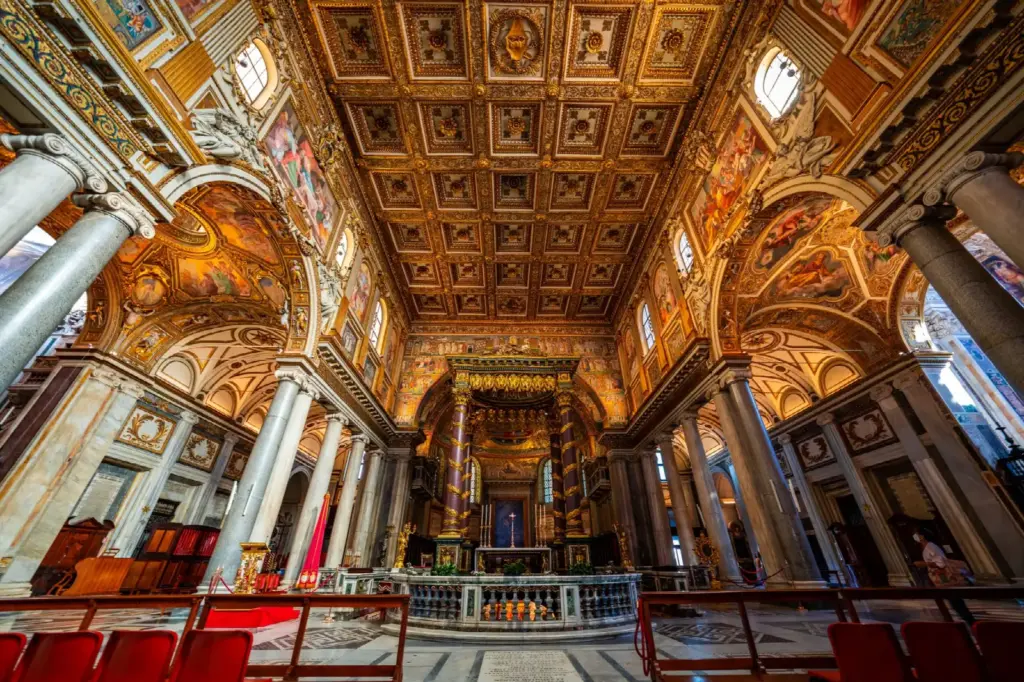
Pope Francis is buried in the Basilica of Santa Maria Maggiore (St. Mary Major) in Rome, not in St. Peter’s Basilica. The Pope Francis tomb is in the left-hand aisle of the basilica, between the Pauline Chapel and the Sforza Chapel. It is a plain marble tomb in a niche, marked only with his papal name in Latin, “Franciscus”. Entry to the basilica is free, so you do not need a ticket to visit Pope Francis’ tomb.
This guide explains when and why he was buried there, what the tomb looks like, how to find it, the dress code and visitor rules, opening times and how to get there from Termini station. Pioneer Tours is an independent tour and ticket company, not the basilica’s ticket office. We sell an optional ticket with priority entry to Santa Maria Maggiore and access to the Loggia of the Blessings and the Liberian Museum, but you do not need it to see the tomb.
Where is Pope Francis buried?
Pope Francis died on Easter Monday, 21 April 2025, at 7:35 am, at his residence in the Casa Santa Marta in the Vatican. He was 88. After his funeral on 26 April 2025, his coffin was brought to Santa Maria Maggiore, where the burial rite began at 1:00 pm the same day, presided over by Cardinal Kevin Farrell, the Camerlengo. The tomb opened to the public the next morning, Sunday 27 April 2025.
Santa Maria Maggiore stands on the Esquiline Hill and is one of Rome’s four papal basilicas. It is in central Rome, outside Vatican City.
Why he chose Santa Maria Maggiore
Francis set out his wishes in a short testament dated 29 June 2022 and published by the Vatican after his death. He wrote that he had always entrusted his life and ministry to Mary, and that he came to pray in this Marian basilica at the beginning and end of every apostolic journey. He asked to be buried in the niche in the side aisle between the Pauline Chapel and the Sforza Chapel, and attached a plan of the spot. He also asked for a plain grave: “The tomb should be in the ground; simple, without particular ornamentation”, bearing only the inscription Franciscus.
The Pauline Chapel holds the icon of the Virgin known as the Salus Populi Romani. According to the basilica, Francis stopped to pray before it 126 times during his pontificate. On 21 April 2026, the first anniversary of his death, the basilica unveiled a commemorative plaque in bronze lettering that records those visits. It is on the right-hand side of the Pauline Chapel as you enter.
What the tomb looks like
The tomb is deliberately simple. According to the Holy See Press Office, it is made of marble from Liguria and carries only the inscription “FRANCISCUS” and a reproduction of his pectoral cross. Vatican News explained that Francis wanted stone from Liguria because it was the land of his grandparents. The reproduction of the plain cross he wore hangs on the wall above the niche. When the tomb opened in April 2025, reporters described a light shining over the stone and the cross.
The area in front of the niche is cordoned off. On the opening day, visitors filed past the niche, many of them crossing themselves, and ushers asked people to keep moving so that the thousands waiting outside could get in.
How to find the tomb inside the basilica
The basilica’s website places the tomb in the left-hand aisle, between the Pauline Chapel and the Sforza Chapel, and Vatican News adds that it is near the Altar of St. Francis. After the security check, go into the church and walk along the aisle on your left as you face the high altar. The tomb is in that aisle, between the entrance to the Pauline Chapel and the Sforza Chapel.
If you are unsure, the entrance portico has panels with a floor plan of the basilica and its main points of interest. The Info Point desk can give you a map and rents out audio guides.
Is the Pope Francis tomb free to visit?
Yes. Entry to the basilica is free, and the tomb is in the main church, so there is no ticket for it. Everyone passes a security check with a metal detector at the entrance.
Tickets are only needed for the separate museum areas run by the basilica. These include the Liberian Museum, the Loggia of the Blessings, the Hall of Popes and Bernini’s Staircase, and the basilica’s website links to an official booking page for them. The museum rooms, opened on 11 December 2024, show a nativity scene made by Arnolfo di Cambio in 1291, which the basilica describes as the first in the history of art, and a room on the Salus Populi Romani icon. The Loggia of the Blessings, built by Ferdinando Fuga for the Holy Year of 1750, frames the medieval mosaic on the façade.
Our Santa Maria Maggiore priority entry ticket is for visitors who want these extra areas. It includes priority entry to the basilica and access to the Loggia of the Blessings and the Liberian Museum, for a self-guided visit without a live guide. Priority entry does not remove the security check, and waits can still be longer on holidays and during religious celebrations. If you only want to see the tomb, the free entry is all you need. For more on the basilica itself, read our guide to visiting Santa Maria Maggiore.
Opening hours
The basilica opens early. The first Mass of the day is at 7:00 am in the Pauline Chapel, next to the tomb, and Reuters reported that the doors opened at 7:00 am on the day the tomb was first open to the public. The basilica’s website does not publish one closing time for the church, and the closing times given by guidebooks and news sites differ, so check before you plan a late-afternoon visit.
Mass times are worth knowing, because the Pauline Chapel next to the tomb holds several Masses each morning. According to the basilica’s timetable:
- Pauline Chapel, weekdays: 7, 8, 9, 10 and 11 am, 12 noon and 6 pm.
- Pauline Chapel, Sundays and feast days: 7, 8 and 9 am.
- Papal Altar, Sundays and feast days: 10 am, 12 noon and 6 pm, with a vigil Mass at 6 pm the evening before.
The basilica sometimes closes for a short time for special ceremonies. On 21 April 2026, the first anniversary of Francis’ death, it closed at 3:00 pm for preparations and reopened at 4:00 pm for the evening celebrations, with entry until it was full. Notices like this appear in the news section of the basilica’s website.
The paid museum areas keep their own hours: Monday to Saturday from 8:00 am to 6:30 pm (last entry 6:00 pm), and Sunday from 12:30 pm to 5:00 pm. All hours can change, so check the official website shortly before your visit.
Dress code and rules at the tomb
Santa Maria Maggiore is a working church, and the tomb is a place of prayer. The basilica’s visitor rules include the following:
- Visitors must be dressed with dignity. Sleeveless or low-cut tops, shorts that do not cover the knees, miniskirts and hats are not allowed.
- Security staff can refuse large bags, suitcases and backpacks, and there is no cloakroom.
- Knives, scissors and metal tools must be handed in at the security check.
- Visitors and guides are asked to keep complete silence.
- Mobile phones may not be used inside the basilica. Flash, tripods and selfie sticks are not allowed.
- Eating and drinking indoors is not allowed, and animals are not admitted, apart from guide dogs.
At the tomb itself, a May 2026 report in the National Catholic Reporter described ushers telling visitors not to take photos. Follow the staff’s instructions, keep your stop short when there is a line behind you, and leave space for people who stop to pray.
Crowds and queues
Expect to wait. Reuters reported that, according to the Vatican, 30,000 people visited the basilica in the first six hours after the tomb opened. A year later, the basilica’s archpriest, Cardinal Rolandas Makrickas, told the National Catholic Reporter that visitor numbers had doubled since the burial, and he estimated 10,000 to 15,000 visitors a day. The same report described a line of visitors along the outside of the church.
No official source publishes waiting times for the tomb. Allow time for the security check, which the basilica says goes faster if you take prohibited items out of your bag in advance and tell the staff about them. Special celebrations can also limit entry, as on the 2026 anniversary, when the faithful were admitted only until the basilica was full.
How to get there
The basilica faces Piazza di Santa Maria Maggiore on the Esquiline Hill. Roma Termini, the city’s main railway station, is a few blocks away and is served by Metro lines A and B, so you can walk from there. Several bus lines also stop nearby.
The basilica has an access ramp for wheelchair users, and mobile platforms give access to the side chapels; ask the staff inside for help. Staff can also show families with pushchairs the easiest route. If you are fitting the visit into a longer trip, our Rome itinerary for 3, 5 or 7 days can help you plan the rest of your time.
FAQ
Where is Pope Francis buried?
In the Basilica of Santa Maria Maggiore in Rome. His tomb is in the left-hand aisle, between the Pauline Chapel and the Sforza Chapel, near the Altar of St. Francis. The basilica is in central Rome, outside Vatican City.
Do I need a ticket to see Pope Francis’ tomb?
No. The tomb is inside the basilica, and entry to the basilica is free. Tickets are only needed for the separate museum areas, such as the Liberian Museum and the Loggia of the Blessings.
Is Pope Francis buried in St. Peter’s Basilica?
No. In his testament he asked to be buried in Santa Maria Maggiore, the basilica where he prayed before and after every apostolic journey, and he was buried there on 26 April 2025.
What is written on Pope Francis’ tomb?
Only his papal name in Latin, “Franciscus”. He asked for this single inscription in his testament. A reproduction of his pectoral cross hangs on the wall above the tomb.
Can I take photos at the tomb?
The basilica’s rules say mobile phones may not be used inside the basilica and flash is never allowed, and ushers at the tomb have been reported telling visitors not to take photos. Follow the staff’s instructions on the day.
Sources
- Testament of the Holy Father Francis, The Holy See
- Pope Francis has died on Easter Monday aged 88, Vatican News
- Pope Francis’ mortal remains buried in St. Mary Major, Vatican News
- Pope’s tomb made of marble from the land of his Italian grandparents, Vatican News
- Il marmo ligure, l’iscrizione: come sarà la tomba di papa Francesco, Avvenire
- Pope Francis’ tomb opens to the public in St. Mary Major Basilica, Associated Press via PBS News
- More than 30,000 people pack Rome church to visit Pope Francis’ tomb, Reuters via The Star
- One year later, Pope Francis’ tomb remains a major Roman pilgrimage point, National Catholic Reporter
- History, Art and Spirituality, Papal Basilica of Saint Mary Major
- First Anniversary of Pope Francis’s Death: Celebrations in the Basilica, Papal Basilica of Saint Mary Major
- 1st Anniversary of the Death of Pope Francis, Papal Basilica of Saint Mary Major
- Press release on the first anniversary of the death of Pope Francis (Italian), Papal Basilica of Saint Mary Major
- Useful Tips for visitors, Papal Basilica of Saint Mary Major
- Celebrations and Timetable, Papal Basilica of Saint Mary Major
- Contact Information and Museum Complex opening hours, Papal Basilica of Saint Mary Major
- Polo Museale, Papal Basilica of Saint Mary Major
- Museum, Papal Basilica of Saint Mary Major
- Loggia of Blessings, Papal Basilica of Saint Mary Major
- Accessibility, Papal Basilica of Saint Mary Major
- Tomb of Pope Francis draws thousands of faithful in year since his death, Africanews and AP
- How to visit Pope Francis’ tomb in Rome, Wanted in Rome
- The Basilica of Santa Maria Maggiore, Turismo Roma